23.04.2026Tomasz Damrecki
Comprehensive Electronics Manufacturing in the Clean-Tech Industry: From PCB Assembly to Final Electromechanical Box Build
The Clean-Tech sector creates energy infrastructure that must survive extreme conditions for many years, operating flawlessly. To meet these rigorous requirements, the highest and most repeatable precision is essential for complex assembly devices.
According to the latest IEA report (Energy Technology Perspectives 2026), the market value of key clean energy technologies (photovoltaics, wind turbines, batteries, EVs, electrolyzers, heat pumps) reached USD 1.2 trillion in 2025; forecasts, which depend on the policy scenario, assume further growth. This represents an unprecedented opportunity for business scaling, but also a massive technological challenge.
Introduction to Electronics Manufacturing
Electronics manufacturing is a complex process where every stage—from concept to implementation—requires precise analysis and optimization. In the Clean-Tech industry, where competition and cost pressures are particularly high, implementing a value engineering (VE) strategy is of key importance. This approach allows for achieving significant optimizations by eliminating unnecessary costs and increasing product value without compromising quality or functionality.
In practice, value engineering involves analyzing all aspects of the product and the manufacturing process to identify areas where optimization is possible. Implementing VE in electronics manufacturing enables better utilization of engineering resources, more efficient material management, and the implementation of innovative solutions that translate into tangible value.
The Landscape of Challenges for OEMs in the Clean-Tech Sector
Manufacturers in the green technology industry operate in a high-pressure environment. Devices for renewable energy sources (RES)—such as control systems for the wind industry—and IoT infrastructure—like smart metering systems—require uncompromising reliability.
In this article, we analyze the main manufacturing challenges faced by OEM manufacturers in the Clean-Tech sector and demonstrate how integrated EMS (Electronic Manufacturing Services)—from precise Surface Mount Technology (SMT) to final electromechanical assembly and box build—solve these problems.
Deloitte's "2026 Renewable Energy Industry Outlook" analysis clearly indicates that leaders in the green technology sector are seeking strategic partners, not just contractors. An experienced EMS partner understands rigorous industry standards. They manufacture to the highest quality standards. They deliver a tested device, ready to operate for decades in extreme conditions.
The Component Life Cycle in the Clean-Tech Industry
The scalability of ecological technologies is strictly conditioned by the stability of supply chains. Along with the exponential growth in the production of devices for the RES sector, the demand for critical raw materials and rare earth minerals increases proportionally. The manufacturing industry faces the necessity of transforming production models. Analyses by the International Energy Agency (IEA) on the component life cycle clearly indicate that without implementing rigorous electronics recycling procedures at every stage of its life cycle, the industry's supply chain liquidity—and consequently, global climate goals—could be permanently threatened.
Microelectronics and the Reliability of Critical Infrastructure
Semiconductors. Without them, every wind turbine, even the most impressive one, is just a majestic pile of useless metal. Literally. All intelligent optimization, real-time inverter monitoring, and precise energy conversion rest on the shoulders of microscopic integrated circuits.
The stability of semiconductor supplies is today a matter not only of ecology but even of the survival of economies. One only needs to glance at the European Commission's official stance on the strategic role of semiconductors in the green transition. Officials directly communicate there that without an indigenous, robust chip manufacturing ecosystem, it is impossible to achieve ambitious climate goals. Clean energy on a macro scale depends entirely on reliability on a micro scale.
Reliability of Electronics Manufacturing for the Wind Industry
A wind turbine nacelle, located at a height of 100 meters, operates in conditions that would destroy many standard industrial controllers. Here, pitch control systems or main PLCs must cope with shocks caused by mechanical vibrations and wind.
Therefore, an analysis of all components and systems is necessary to ensure the reliability and cost-effectiveness of the solutions. Any optimization efforts or cost reductions must be carefully evaluated. Maintaining the operational quality of the device is essential.
A nacelle operates in even more extreme conditions in the open sea; here, electronics battle not only physics but also chemistry. In addition to vibrations and temperature fluctuations, there is an omnipresent, highly corrosive salt fog and extreme humidity. Under such conditions, standard insulation is not enough.
Therefore, a rigorous MTBF analysis of each component is crucial. Optimization? Yes, but only on the condition of maintaining full redundancy and immunity to electromagnetic interference, which is the norm for generators of this power. In the offshore or even onshore industry, reliability is the only way to make the project's economic calculation add up.
Electronics Assembly and Final Assembly Under One Roof
A fragmented supply chain—involving outsourcing Printed Circuit Board Assembly (PCBA) to one subcontractor, cable harness production to another, and handling final assembly in-house—generates so-called operational bottlenecks. This leads to:
- An increased risk of quality errors at the interface between suppliers.
- A dilution of warranty liability.
- A significant extension of the Time-to-Market (TTM) indicator.
The solution to these problems is the consolidation of manufacturing with a single, technologically advanced EMS partner.
Analyzing the cost structure and the manufacturing process allows for optimizing efficiency and reducing costs at every stage of production. Additionally, involving the procurement department in optimizing purchasing processes and negotiating with suppliers enables even greater cost efficiency within integrated EMS services.
Let us analyze this across two exemplary areas of our specialization: wind energy systems and smart metering systems.
Service Costs and Failure Rates
A persistent challenge for OEMs is minimizing service interventions. They generate massive financial losses. Achieving the required MTBF target of tens of thousands of hours depends directly on the stability of manufacturing processes. It is precisely the repeatable and rigorous electronics assembly that determines a device's resistance to failures in environments with high vibration amplitudes and humidity.
Simply designing a robust circuit is not enough if the assembly process does not eliminate the risk of latent defects. The most common faults, such as microcracks in solder joints caused by vibrations or electrochemical corrosion of traces induced by condensation, are usually the result of errors in the SMT or conformal coating process. Preventing them requires the use of precisely calibrated soldering profiles and automated optical and X-ray inspection, which guarantee the absence of air voids inside the solder.
HMLV and Smart Automation for the Clean-Tech Industry
The growing role of specialized components—including AI accelerators for predicting energy consumption, advanced sensor arrays, or V2G (Vehicle-to-Grid) communication modules—causes the number of possible product combinations to grow exponentially. EMS providers who can efficiently manage this complexity in an HMLV model, eliminating the risk of configuration errors and delays, gain a market advantage. A key element of this collaboration is supporting OEMs during the iteration phase and testing of short runs prior to their full scaling. The ability to smoothly guide a product through the pilot stage allows EMS companies to transform from a mere contractor into a strategic partner in the supply chain of low-emission technologies.
HMLV (High-Mix Low-Volume) refers to manufacturing a high variety of products in small quantities. In this model, what matters is the operational management skill to transition from one complex project to another while maintaining surgical precision.
Lean Manufacturing Principles in HMLV Production
Lean Manufacturing practices constitute a key control mechanism over process complexity. Their proper implementation allows for maintaining quality and reducing waste. Fundamental practices include:
- SMED (Single-Minute Exchange of Die): A methodology allowing the reduction of line changeover times to an absolute minimum. In the HMLV model, it is the only way to maintain a high machine park utilization rate during frequent transitions between different device variants (e.g., from BMS modules to inverter controllers).
- Standardized work instructions: These guarantee full repeatability of operations even with a vast variety of assortments. Thanks to them, every stage of electromechanical assembly proceeds according to a strictly verified procedure, which minimizes the risk of quality errors.
- Pull systems and Kanban: Mechanisms that adjust the production pace to actual market demand rather than unreliable forecasts. In the rapidly changing RES sector, this prevents overproduction and the freezing of capital in components that could become obsolete.
- Kaizen: A culture of continuous improvement focused on eliminating micro-inefficiencies. It enables the systematic stabilization of workflows and the optimization of process costs, which is critically important when scaling innovative energy projects.
Flexible Automation
Flexible automation must support variability and be configurable. A good example is Cobots (collaborative robots), which eliminate manual errors during the assembly of complex power electronics. Workstations equipped with vision-based part recognition and dynamic adaptation of pick-and-place behaviors reduce the need for manual sorting.
In the Clean-Tech sector, where the specifications for devices such as EV charging stations, inverters, or energy management systems evolve dynamically, additive manufacturing techniques (3D printing) serve as a key accelerator for implementation processes. It allows for the near-instantaneous fabrication of precise assembly jigs, custom enclosures with a specific ingress protection rating, and adapters for Functional Tests (FCT). Such an approach drastically shortens the readiness time for producing subsequent variants and eliminates the high initial costs associated with line changeovers.
Precise PCB Assembly and Protection Processes
An EMS partner with extensive experience serving the wind energy sector implements rigorous processes that eliminate risks at every stage of production. Prior to commencing mass production, analyzing the design against the requirements of the IPC-A-610 standard in the highest Class 3 (high-reliability products) is exceptionally important.
DfM (Design for Manufacturing) Analysis
DfM analysis is a stage that ruthlessly verifies the project's feasibility against the physical realities of the production floor. This process relies on an in-depth technical assessment of engineering details: from checking the physical clearances between components for the collision-free operation of Pick & Place machine heads, to a rigorous inspection of footprint correctness. Advanced panelization optimization is also an exceptionally important element. Proper structural planning on the one hand allows for minimizing the waste of expensive laminate, and on the other—drastically reduces the risk of mechanical damage during the depanelization process. Precise layout eliminates dangerous stresses that could lead to microcracks or permanent damage to sensitive components placed on the edges of the board. Catching these types of error vectors as early as the Gerber file verification stage requires analytical rigor. However, it is precisely a meticulously conducted DfM that provides the ultimate guarantee that a theoretical design will be smoothly and flawlessly forged into stable, repeatable production.
Environmental Protection (Conformal Coating and Potting)
Assembled electronic boards (PCBA) for wind turbines should be subjected to conformal coating processes. Acrylic, silicone, or polyurethane resins create a barrier against moisture and dust. For components exposed to the highest vibrations, a potting process is applied, which completely encapsulates the modules with dedicated compounds; this not only stiffens the structure, protecting solder joints against fatigue cracking and aggressive chemical agents, but with the appropriate material selection, it also significantly improves heat dissipation. It is this synergy of coating and encapsulation that is the key to achieving a high MTBF (Mean Time Between Failures) rate and minimizing costly service interventions at wind farms.
Rigorous Inspection and Testing
Utilizing 3D AOI (Automated Optical Inspection) systems and 3D X-Ray inspection ensures the integrity of every solder joint, especially under BGA components, which are increasingly common in industrial controllers. Rigorous testing of these systems is crucial to ensuring high product quality and the reliability of electronic components, which directly impact the product's functionality and durability. Equally important are environmental tests (climatic chambers) simulating the real operating conditions at a wind farm.
Quality Management Systems and Manufacturing Standards
Declarations of "high quality" are not enough. Evidence of a contract electronics manufacturer's competence should be based on international standards, the successful implementation and maintenance of which is possible thanks to the involvement of specialized engineering teams responsible for compliance and the development of quality standards.
It is worth emphasizing the following pillars in discussions:
Standard / System | What does this mean technically? |
IPC-A-610 (Class 3)
| The highest acceptability standard for electronic assemblies. Requires absolute soldering precision. |
ISO 9001 & ISO 14001 | Quality and environmental management systems. |
Traceability | The client and the EMS provider should jointly select the appropriate solution, evaluating how deeply the product's material structure needs to be analyzed. |
Automation and Traceability
To meet manufacturers' demands, the production process should be based on three pillars: automation, monitoring, and continuous improvement. Automation allows for increased production efficiency and repeatability, while also minimizing the risk of human error. Access to up-to-date data on supplier prices and material costs enables rapid optimization decisions.
Digital integration across engineering, procurement, and logistics is an absolute necessity in risk and quality management within the EMS industry. Only a seamless flow of data guarantees a project's success. One example of such integration is an ERP system with an MRP II loop.
High-Performance SMT Lines
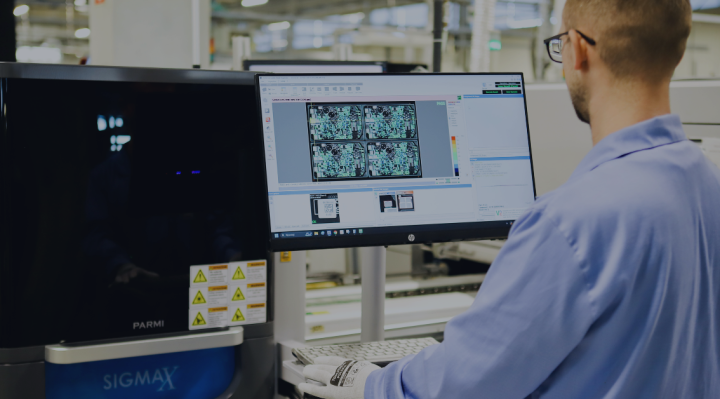
Surface mount assembly lines should be modern and capable of adapting to changing product dynamics. Automated SPI systems inspect the volume and shape of the applied solder paste, which, in the production of radio modules, among others, eliminates 80% of potential soldering defects.
Manufacturing Process Traceability
Thanks to implemented MES systems, material tracking control is possible from the component level to the finished device. Manufacturers receive a guarantee that if a defect is detected in a specific batch of microcontrollers from a supplier, we can identify and withdraw exclusively those meters that received the faulty parts, thereby protecting the brand's reputation.
Secure Programming and Testing (FCT / ICT)
The product verification process relies on a two-stage testing cycle that eliminates the risk of costly failures before the product reaches the final recipient.
The first level of advanced control is the ICT (In-Circuit Test), which measures the parameters of the PCBA. Contrary to common oversimplifications, this stage does not examine the internal structural integrity of the subassemblies, but rather performs a precise verification of the electrical values of the designated majority of elements on the board. The system measures the parameters of key components—from resistors to transistors—although, for technical reasons, it does not encompass absolutely all 100% of the implemented circuits. Focusing on the physical measurement of designated test points, however, allows for the immediate detection of critical assembly errors, such as using a component with the wrong nominal value, short circuits, or open tracks. These are latent defects that, by their very nature, even the most advanced Automated Optical Inspection (AOI) cannot detect.
The true acid test, however, is the FCT (Functional Test). It is here that the device undergoes an examination under conditions simulating real-world operation: from applying high voltage, through verifying energy consumption measurements, to establishing a secure network connection and validating data packet encryption.
Detecting a potential fault directly at the plant enables an immediate engineering intervention, completely eliminating the risk of errors occurring on the client's end and avoiding the massive costs of service logistics.
Why is PCB Assembly Not Enough?
In the Clean-Tech industry, an assembled board alone is only half the battle. Only full integration of electronics with advanced mechanics, thermal management systems (heatsinks, fans), and specialized cabling makes it possible to achieve the required ingress protection (IP65/67 classes) and vibration resistance. Choosing an EMS partner who offers PCB assembly, box build, and systems integration all under one roof simplifies the supply chain and reduces logistics costs.
Comprehensive Electromechanical Assembly (Box Build)
Transitioning from a board assembly service to full electromechanical assembly with a single EMS partner is a milestone in optimizing Clean-Tech manufacturing. What are the benefits of integrating both services under one roof?
- Supply chain consolidation: shifting the burden of managing the entire BOM. Contract electronics manufacturers possess a global network of suppliers, allowing them to negotiate better pricing for mechanical components, sheet metal, and cables, as well as actively manage the component life cycle.
- Advanced Box Build: final assembly workstations are adapted for both the integration of small smart meters and the construction of large-scale control cabinets, switchgears, and HMI panels for the wind energy sector.
- Cable harness manufacturing and testing: preparing and testing cable harnesses. This eliminates the risk of incompatibility between the board and the signal or power wiring.
- Final testing of the complete system: Instead of testing just the "board," the entire product is tested. Box Build enables final High-Pot (dielectric withstand) and grounding tests, as well as the ultimate functional quality control of the entire system before packing it into custom packaging and shipping it to the end customer.
Managing the Bill of Materials (BOM)—where, alongside hundreds of electronic components, there are enclosures, displays, connectors, gaskets, and custom cable harnesses—is a logistical nightmare. Every delay on the plastics supplier's end blocks the final assembly. Additionally, during systems integration (e.g., placing a PCBA inside a control cabinet for a wind turbine), the engineering experience of the supplier and the high competence of the staff in thermal management (heat dissipation via heatsinks, thermal pastes) and compliance with ingress protection standards (IP65, IP67) are crucial.
Why Does Experience Matter?
Every product that rolls off the line is a direct showcase of the OEM brand. This requires the EMS provider to have not only a modern machine park but, above all, an engineering work culture based on knowledge and procedures.
By collaborating with an experienced contract electronics manufacturer in the Clean-Tech sector, an OEM:
- Lifts the burden of material logistics, manufacturing process quality management, and facility maintenance off its own shoulders.
- Gains a faster Time-to-Market thanks to properly structured NPI (New Product Introduction).
- Can focus on designing the next breakthrough technologies for a sustainable future, instead of solving problems with wave soldering or enclosure leak testing.
Manufacturing in the Clean-Tech era requires the synergy of silicon chips, complex mechanics, and flawless assembly processes. Guiding a product from a bare PCB to a finished device functioning in a harsh environment is the art of integration. By choosing a partner who combines perfect PCB Assembly with comprehensive electromechanical assembly, you choose security, scalability, and success in the growing green technology market.